

Advancing Responsible Water Stewardship
Our Approach
Water stewardship at Hindustan Zinc is guided by its Water Management Policy, and shaped by the ICMM Mining Principles, particularly Principle 6 (Environmental Performance) and the ICMM Water Stewardship Position Statement. Our water stewardship efforts also align with SDG 6: Clean Water and Sanitation. This framework emphasises responsible water governance, efficient water use, protection of shared water resources, and transparency across the asset lifecycle, including closure. In line with these principles, we seek to identify, assess, and manage water-related risks and impacts, strengthen site-level water governance, and support catchment-level water security. Through efficient water use, zero liquid discharge practices, and responsible engagement with stakeholders in water-stressed regions, we plan, use, and safeguard water resources to support long-term water security for ecosystems, communities, and future generations.
 Read about our water-related goals under the Sustainability section.
Alignment with Global Water Stewardship Frameworks
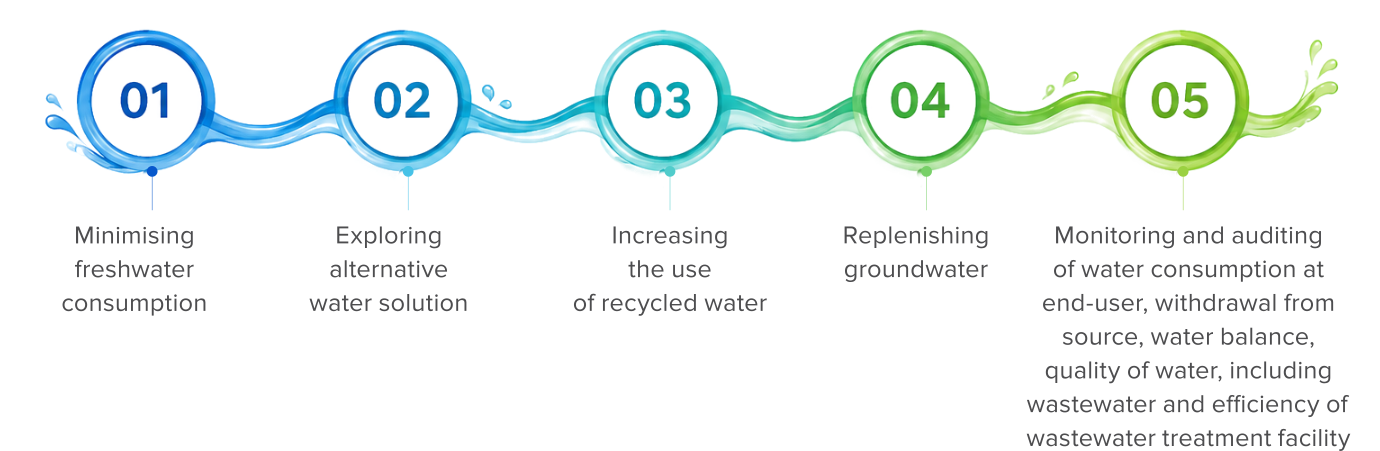
We align with the UN Global Compact Water Action Platform (CEO Water Mandate), adopting its strategic framework to drive responsible water management. We are constantly working to improve our water stewardship maturity framework in line with ICMM requirements, which include:
Advancing Water Circularity Through Water Treatment Systems
We maintain zero liquid discharge (ZLD) at all active sites. We are continuously expanding our waste water treatment facilities across the units to enhance our water recycling and recovery through closed-loop water management approach. We also manage process water by treating it at on-site state-of-the-art effluent treatment plants (ETPs). These efforts have significantly improved water efficiency and reduced freshwater withdrawal, reinforcing a future-ready water strategy with a focus on maximising recovery, reducing dependence on freshwater, and embedding circularity across operations.
Key Highlights in FY2026
Water Treatment Plant
Benefited from phase 1 of a 4,000 KLD unit at Rampura Agucha Mine, with another 4,000 KLD unit underway at Chanderiya Lead Zinc Smelter
Water Savings
1.65 million m³ of water savings achieved through recycling projects and advanced treatment systems, enabling internal reuse
Strengthening water recovery with advanced tailing filteration solutions
We continued to scale up innovative tailings management technologies by commissioning a second filtered tailing plant at Rajpura Dariba Complex, building on the success of India's first facility at Zawar Mines. This technology significantly reduces the environmental footprint of tailings handling by producing filtered tailings while enabling high levels of water recovery. The deployment of filtered tailing technology is driving multiple sustainability benefits, including:
- Enhanced water recovery and lower freshwater withdrawal
- Improved safety and stability of tailings infrastructure by reducing reliance on conventional tailings dams
- Reduced waste volumes and more efficient land use through filtered tailings
- Lower environmental risk and stronger long-term operational resilience
Key Highlights in FY2026
(c.5,000 m³/day of reclaimed water) achieved through filtered tailing plants, with a 5% increase in water recycling at Rajpura Dariba Complex
Creating water-positive futures for our communities
Hindustan Zinc continues to set higher benchmarks of water positivity and responsible water management through sustained efforts in large-scale rainwater harvesting, groundwater recharge, and extensive process water recycling.
Over the past five years, we have worked closely with communities in water-stressed regions to strengthen local water security. Through more than 280 water-related interventions covering rainwater harvesting structures, pond deepening, check dam construction, and provision of freshwater infrastructure, we have significantly enhanced water resilience in surrounding communities.
Key Highlights in FY2026
achieved, independently verified by a third party. This shows a significant increase from 2.41x in FY2020
created through 280+ water-related interventions
Strengthening Water Risk Management for Long-Term Resilience
We adopt a risk-based, basin-level approach to water stewardship, recognising water as a shared and increasingly constrained resource across our operating geographies. Water-related risks, including scarcity, variability, regulatory changes, and competing demand, are periodically assessed using globally recognised tools and are integrated into site-specific water management plans. These assessments incorporate sensitivity analysis, stress testing, and evaluation of potential regulatory shifts to ensure a comprehensive understanding of water-related risks.
Given the variability of water risks across regions, we use multiple globally recognised tools, such as the WBCSD India Water Tool, WRI Aqueduct and GEMI Local Water Tools, to analyse factors including water stress, seasonal fluctuations, flooding and drought exposure, groundwater status, and future risk scenarios.
Insights from these assessments guide the development of site-specific risk mitigation strategies. Futuristic analysis using the Aqueduct Water Risk Atlas has highlighted high water stress zones at several locations, reinforcing the need for proactive planning. Through this data-driven approach, we remain committed to safeguarding operational continuity while minimising impacts on local communities and ensuring water security well into the future.
Strategy Aligned to Local Watershed Risk & Stakeholder Context
Water risks are prioritised based on basin-level stress and their potential impacts on operations and communities, guiding the design of mitigation measures, capital allocation, and expansion planning. High-risk sites are subject to enhanced controls, including zero liquid discharge systems, filtered tailings management, and increased water recycling.
Planning for Capacity Doubling: Water by Design
As we plan to double capacities, water efficiency is being engineered into new assets from the outset. Expansion projects follow a "water by design" principle:
This ensures that growth does not increase freshwater intensity, keeps us aligned to 2030 targets, and safeguards shared watershed resilience.