


Tailings Management
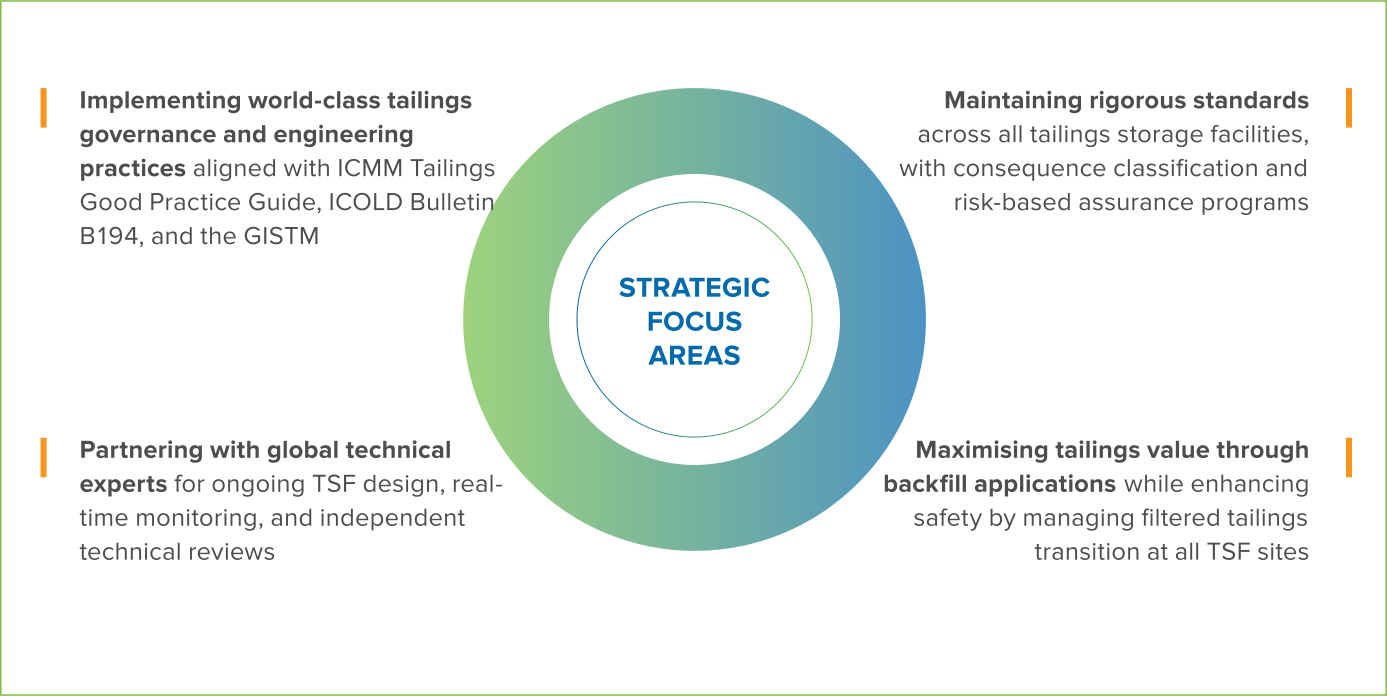
Hindustan Zinc is implementing a comprehensive Tailings Management Framework aligned with its Tailings Management Policy and the Global Industry Standard on Tailings Management (GISTM). The Framework (Tailings Management Systems-TMS) prioritises the reduction of risk and the safety of employees, communities, and the environment across the full lifecycle of tailings storage facilities (TSFs), supported by robust engineering design, continuous monitoring, regular stability assessments, and independent technical reviews to ensure long-term integrity and risk minimisation.
Hindustan Zinc operates multiple tailings storage facilities across its mining operations, which are systematically inventoried and classified based on consequence in alignment with GISTM. Facilities are classified according to potential downstream impacts, with governance, monitoring, and assurance measures applied proportionate to their consequence classification. The Company currently manages five tailings facilities across three sites, all of which are in active use. Each facility requires careful monitoring and maintenance to manage risks and ensure they operate within safety guidelines.
 For further information, please refer our approach on Tailings Management.
Robust TSF Governance Framework
Hindustan Zinc maintains a comprehensive tailings storage facility (TSF) governance structure aligned with GISTM principles, featuring Board and CEO oversight, an Independent Technical Review Board (ITRB), and Tailings Community of Practice (CoP) meetings. The Accountable Executive (Chief Operating Officer) enforces compliance with our Tailings Management Policy, internal standards, and GISTM requirements across the full TSF lifecycle, from design and operations, through closure and post-closure. His responsibilities are delegated through the IBU CEOs. This multi-layered approach targets zero harm to people and the environment by proactively addressing short- and long-term risks, including catastrophic failure prevention.
Key Highlights
- Commissioning of filtered tailings plants at Zawar and Rajpura Dariba Complex
- Planning and design at Rampura Agucha Mine is at the advanced stage and is expected to be initiated by FY2027
- Revised dam-break analysis for tailings storage facilities across all mine sites to identify and close gaps, strengthen engineering controls, reduce failure risk, and enhance emergency preparedness
- Advanced our filtered tailings journey by operating filtered tailings plants (FTPs) at Zawar and Rajpura Dariba, with the Rampura Agucha FTP progressing, enabling a reduction in risk from completely wet tailings, improved management of water usage, and improving environmental safety
- Enhanced and initiated a comprehensive Tailings Management Framework that guides safe, efficient storage and helps maintain the structural integrity of all tailings storage facilities
- Strengthened oversight through a dedicated Tailings Management Community of Practice (CoP), which drives implementation of our Tailings Management Policy and GISTM requirements while fostering continual improvements in safety and operational performance
- Strengthened our alignment with the GISTM, with full implementation by FY2027 end
- Continued aligning site-level tailings practices with ICMM principles and global good practices, embedding these requirements into day-to-day operations
Managing Tailing Storage Facilities (TSF) With Leading Global Standards
Our TSF designs, operation, and closure practices will align with leading international standards, including GISTM, ICMM guidance, and applicable national regulations.
- Robust Tailings Management Policy with firm organisational commitment to safe practices
- Dedicated TSF Committee of internal experts, driving GISTM compliance
- Engagement of leading engineering firms for TSF design and oversight
- Regular TSF risk assessments with targeted mitigation measures
- Tailings reuse via paste-fill and hydro-fill backfilling applications
- Transition from wet to filtered tailings disposal systems
- Recovery and recycling of supernatant water for operational use
- Garland drains around TSFs maintaining zero liquid discharge
- Deployment of satellite-based interferometric synthetic aperture radar (InSAR) monitoring technique to provide early warning of surface ground movements
At Hindustan Zinc, we are committed to implementation of GISTM and to managing our TSFs in a safe and environmentally responsible way, without compromising on the health and well-being of our employees as well as communities. The Tailings Management Framework is an essential prerequisite for sound tailings governance and provides the strategy for implementing the Tailings Policy and GISTM, as most failures of tailing storage facilities around the world result from inadequate governance and management. Effective implementation of the Tailings Management Framework not only results in safer TSFs but will frequently reduce overall costs associated with operation and closure of the facility. The main focus of management of tailings facilities is to prevent potential flow failures. Each facility requires careful monitoring and maintenance to manage risks and ensure they operate within safety guidelines.
Advanced Geotechnical Monitoring
It is intended to enhance monitoring by adding state-of-the-art monitoring technologies to safeguard tailings dam stability, including:
- Total station surveys tracking slope movements
- Vibrating Wire Piezometers (VWP) monitoring pore water pressures
- InSAR satellite monitoring to measure long-term surface deformations
- Real-time water monitoring supported by satellite imagery
- Seepage flow monitoring
- Inclinometers detecting subsurface deformations
- CCTV systems for continuous security and visual inspections
Commitment to Leading the Way in Tailings Safety and Transparency
Hindustan Zinc is dedicated to enhancing the safety and transparency of its tailings facilities through a range of initiatives, including the adoption of international standards such as the Global Industry Standard on Tailings Management (GISTM) and the Tailings Management Guidelines set by the International Council on Mining and Metals (ICMM).
Strengthening Biodiversity Stewardship Across the Mine Lifecycle
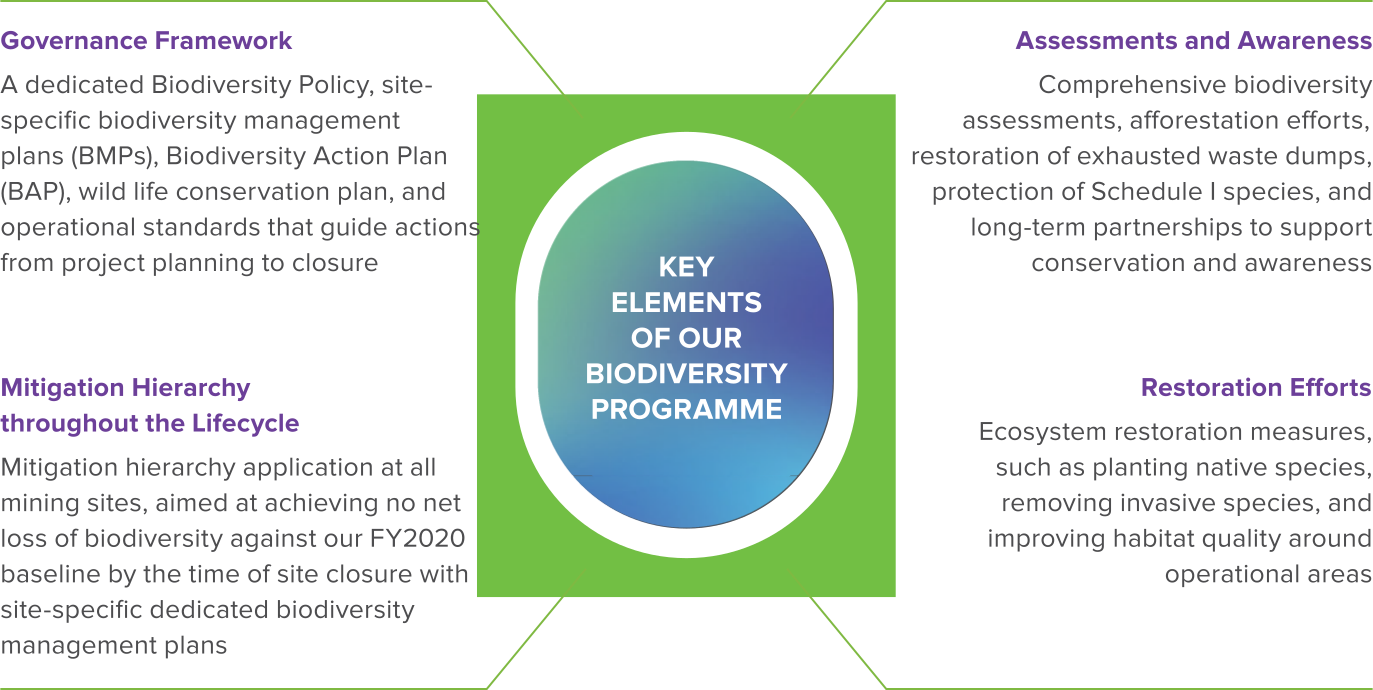
We are committed to protecting and enhancing biodiversity across the full lifecycle of our operations. Aligned with the ICMM Mining Principle 7 and Nature Position Statement, we work closely with recognised expert organisations to minimise impacts and strengthen ecosystem resilience. Our approach is grounded in science-based planning, continuous assessment of biodiversity risks and dependencies, and proactive conservation actions, in line with our Biodiversity Management Policy.
For further information please refer to HZL's approach on Biodiversity Management.
Strengthening Transparency Through TNFD Leadership
Hindustan Zinc is an early adopter of the Taskforce on Nature-related Financial Disclosures (TNFD) framework. As active TNFD member, we contribute to the evolution of the framework through ongoing feedback. Our participation in the Taskforce on Nature-related Financial Disclosures (TNFD) strengthens integration of nature-related risks, dependencies, and opportunities into core business and financial decision-making. This approach enables us to systematically evaluate how ecosystem changes may affect our operations while ensuring greater transparency and accountability in our nature-related reporting.
Site-Specific BMPs in Collaboration with IUCN
We updated biodiversity management plans (BMPs) for all operational sites, achieving a major milestone in our three year collaborative programme with the International Union for Conservation of Nature (IUCN). These IUCN-guided plans provide a science based roadmap to achieve no net loss (NNL) of biodiversity by closure, aligned with global best practices.
The collaborative exercise includes:
- Revising our biodiversity policy, technical standards, and guidance framework to align with international benchmarks and support our NNL ambition
- Evaluating and updating existing BMPs, integrating global best practices and developing site-specific protocols for biodiversity and ecosystem services management
- Creating annual action plans with clear activities, budgets, and timelines that align with the updated BMPs and corporate biodiversity commitments
- Building internal capability through training programmes that enhance employee understanding of biodiversity and ecosystem services management
- Establishing a year-on-year pathway to achieve no net loss, supported by targeted interventions at each site
- Assessed ecosystem-related risks and opportunities by evaluating the impacts and dependencies of our operations on local ecosystems, supported by the development of detailed, site-specific BMPs for all Rajasthan units
Transforming Wasteyard Into High-Density Green Belt
We successfully revived 22.25 hectares of wasteland at the Chanderiya Lead-Zinc Smelter into a thriving greenbelt, using Mycorrhiza technology in collaboration with The Energy and Resources Institute (TERI). This technology fosters a symbiotic relationship between plants and fungi, enabling vegetation to thrive in challenging conditions.
Scaling Green Cover
The initiative was carried out in two phases: 6.5 hectares in the first phase in FY2024 and 16 hectares thereafter. The initiative led to the plantation of c.56,400 native trees, creating a high-density green cover.
Ecosystem Impact and Recognition
The current phase aims to stabilise dump slopes, control erosion, and boost carbon sequestration. The project was recognised with the CII National Award for Environmental Best Practices and highlights the Company's commitment to enhancing biodiversity and protecting natural ecosystems.
Plantation and restoration pledge of Baghdarra Crocodile Reserve
Hindustan Zinc, in partnership with the Forest Department, Udaipur, launched a large-scale plantation drive at the Baghdarra Crocodile Conservation Reserve under the Hariyalo Rajasthan and Ek Ped Maa Ke Naam initiatives. The Company planted 500 native saplings and committed to nurturing 5,000 more to bolster habitat biodiversity, green cover, and local ecosystems.
Through a ₹ 5 crore MoU with the Forest Department, this public-private collaboration will support the ecological rejuvenation of nearly 400 hectares. The effort aims to restore wetland ecosystems, enhance biodiversity, protect marsh crocodiles, and foster community participation in Rajasthan's vital conservation landscape.