Global Standards Alignment
- Working towards aligning fully with the ICMM Mining Principles, Performance Expectations, and Position Statements




At Hindustan Zinc, guided by our ‘Zero Harm, Zero Waste, and Zero Discharge’ vision, we are tangibly progressing towards a sustainable future, aiming for the SBTi-validated Net Zero target by 2050 or sooner.
The Company has implemented an Integrated Management System (IMS) across all its operational units. Each site holds valid certifications to internationally recognised standards, including ISO 9001 (Quality Management), ISO 14001 (Environmental Management), ISO 45001 (Occupational Health & Safety Management), and ISO 50001 (Energy Management), reflecting a unified and robust approach to quality, safety, environmental protection, and energy efficiency across its mining, smelting, and refining operations.
Hindustan Zinc follows a Sustainability Framework adopted from its parent company, which is aligned with the guidelines from International Finance Corporation (IFC) and International Council on Mining & Metals (ICMM). It provides a structured approach to embed sustainability in operations and decision-making through well-defined sustainability policies, standards, and guidance notes that support operational and social excellence.
Having come a long way in our sustainability efforts, from pioneering low-carbon innovations to championing biodiversity and social development, we are now embarking on the next, more profound chapter – Sustainability 2.0. We are embedding perseverance, accountability, and global benchmarking into our core strategy. This evolution reflects a transformational shift towards purpose-led, inclusive, and future-ready operations.
S&P Global ESG Leader
No. 1 globally in Metals and Mining for the third consecutive year, with an overall score of 90 (up from 77 in FY2021).
Featured for the ninth consecutive year in Sustainability Yearbook 2026 – among the top 1% of most sustainable organisations globally. Also, included in the Dow Jones Best-in-Class (DJBIC) Index (Emerging markets) for the first time.
Our three-tier governance structure enables us to integrate sustainability into every aspect of our decision-making from setting the vision at the top to driving its implementation on the ground.
Committee details - Three Directors
Meeting frequency - Half-yearly
Mandate - Oversight of ESG matters and strategic direction
 Read more on the Committee’s members and its role in Corporate Governance Report
Committee details -
Chairperson: Chief Executive Officer
Members: Entire Executive Committee and chairpersons of our 12 communities, including:
Meeting frequency - Monthly
Mandate -
Committee details - Chaired by CEOs of independent business units (IBUs) and includes the site-level community heads
Meeting frequency - Monthly
Mandate -
Under our Sustainability Assurance Programme, each site is systematically assessed annually across 13 key pillars to measure implementation of the sustainability framework and assign site-specific sustainability scores. The outcomes of the assessment are discussed in the Executive-level Sustainability Committee, which in turn reports to the Board. The outcomes flow directly into corrective and preventive action plans, periodically reviewed, evaluated, and documented by the business units.
10% of the annual performance bonus and incentives of the leadership and employees are linked to the Sustainability Assurance Score. Long-term incentives are also linked to the broader ESG performance of the Company, driving accountability across all levels.

Compliance

Leadership

Objectives, Targets & Performance

Safety

Competency & Training

New Projects

Process Safety & Management of Change

Incident Investigation

Assessment and Continual Improvement

Supplier & Contractor Management

Social Sustainability & Stakeholder Engagement

Environment

Occupational Health
Hindustan Zinc has consciously extended its sustainability culture to the customers and suppliers, key stakeholders for Hindustan Zinc. The customer service proposition is built around our wide portfolio of products and transparent disclosure of the environmental impact of our products.
Published an independently verified Environmental Product Declaration (EPD) for our zinc products, assessing their environmental impacts, using Life Cycle Assessment (LCA) based on Cradle-to-Gate approach.
Our Zinc EPD is compliant with ISO 14025:2006 and EN 15804:2012+A2:2019, and benchmarked to ISO 14040 and ISO 14044, enabling consistent comparison for global customers.
Launched EcoZen in FY2025, Asia’s first low carbon zinc and expanded its adoption across the manufacturing industries through strategic partnerships in FY2026, addressing value chain emissions.
EcoZen has 75% lower carbon footprint vs the global average and is certified to have <1 tCO₂e per tonne of zinc produced.
were assessed
for ESG Risks
Our sustainability ambition reset marks a decisive shift from the Sustainability Goals 2025 to the 2030 goals. It strengthens accountability, stakeholder integration, and global benchmarking to drive higher-impact outcomes across climate action, water stewardship, inclusive growth, and governance excellence.
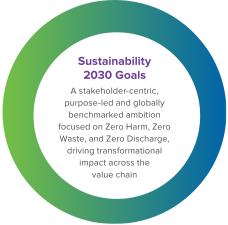
Our Sustainability 2.0 vision is anchored in a strengthened governance framework, enhanced accountability, and a clear commitment to global best practices, ensuring sustainability is embedded across every layer of operations.

Reduction of Scope 1 and 2 emissions by 50% and Scope 3 emissions by 25%


Achieve near to Zero waste to landfill by diverting all smelting process waste away from landfill through reuse, recycling, and recovery


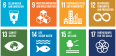


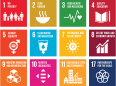
*Except Responsible sourcing (baseline FY2025), baseline for all others is FY2020